
Reading the suits on a tile face
Dots, bams and cracks, then the honors and the jokers. What the letters and numerals on our faces are doing, why color helps a new player, and how to teach the wall in one evening.
Nobody learns mahjong from a diagram. People learn it by sitting down, picking up a tile they cannot read, and asking. What follows is the answer we give, in the order it stops being confusing.
Three suits, nine ranks, four copies
Everything begins with the same arithmetic. Three suits run one through nine, and each rank appears four times, which is where 36 dots, 36 bams and 36 cracks come from. Learn that one number and the rest of the set explains itself.
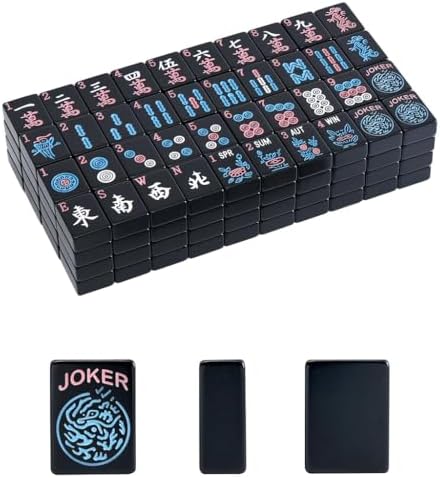
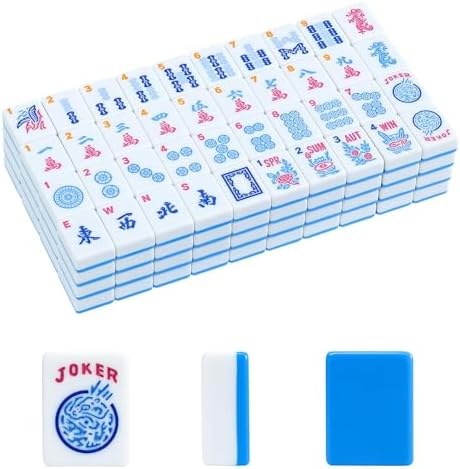
Dots are circles, and counting them is the whole trick. Bams are bamboo sticks, drawn as stacked segments, except for the one bam, which is a bird on almost every set ever made and confuses every new player exactly once. Cracks carry a Chinese character above a numeral, and on our American faces the numeral is Arabic, which is why cracks are usually the first suit a beginner reads fluently.
The honors
Winds are east, south, west and north, four of each, which makes 16. Dragons come in red, green and white, four of each, which makes 12, and the white dragon is often a blank or an outlined frame rather than a picture. Flowers add another 16 on an American set and they are the decorative ones, painted with seasons and plants, which is why flowers are also the tiles most likely to fade first on an old set.
Jokers, and where the count comes from
An American set adds 8 jokers, and that is the tile that makes the total 166 rather than the 144 a Chinese set carries. We pack spare jokers and blank tiles alongside, because jokers get handled more than anything else on the table and a set without one is a set that plays differently.
Color is a reading aid, not decoration
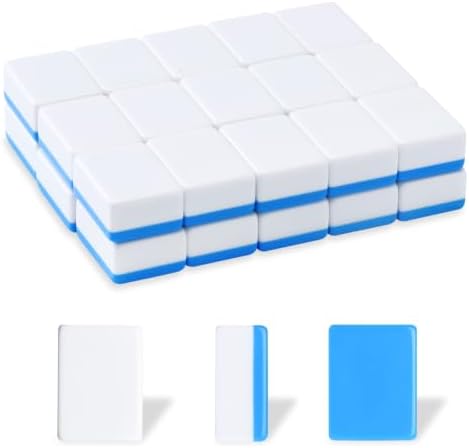
We make tile faces in white, black, blue, light blue, green, light green and pink, and we make the printed acrylic faces too. This is partly taste and partly eyesight. A high-contrast face across a 31.5 inch mat is easier on everyone at the far corner, and a group that plays in the evening under one overhead light will feel the difference within a hand. If somebody at your table squints, that is a tile color problem more often than it is a lighting problem.
Teaching a table in one evening
- Deal out one full suit face up and let the new player put it in order. Five minutes, and dots stop being a puzzle.
- Do the honors as a separate pile. They are memorized, not counted, and mixing them into the suit lesson slows both down.
- Numbered faces earn their keep here. Our numbered Chinese sets print the numeral next to the traditional mark, and a beginner reads them without translating.
- Leave the hand card for the second evening. Reading tiles and reading hands are different skills and stacking them is how people quit.
When the faces stop being readable
Engraved faces last because the paint sits in a groove, but a set that has been played weekly for a decade earns its wear honestly. Rather than retire it, re-face it. A full sheet of 166 decals in the standard 1.2 inch size puts crisp marks back on tiles that are otherwise perfect, and the set that taught your table stays the set your table plays on. Decals sit in table extras, next to the mixers and the card readers.
Tiles on their own, by face and color
More from the game room
American or Chinese: which set are you actually shopping for
The two games share a name and almost nothing else at the table. Tile counts, faces, racks and what each style needs before four people can sit down.
At the tableSetting the table for four
What goes down first, how much table four seats really need, and the small placements that stop a game stalling. Our own setup order, from bare wood to first wall.
CareKeeping melamine tiles clean, and the mat under them
Melamine resists scratches and hates hot water. What we use on tiles, what the mat instructions actually mean, and the storage habits that decide how a set ages.